No Backstage
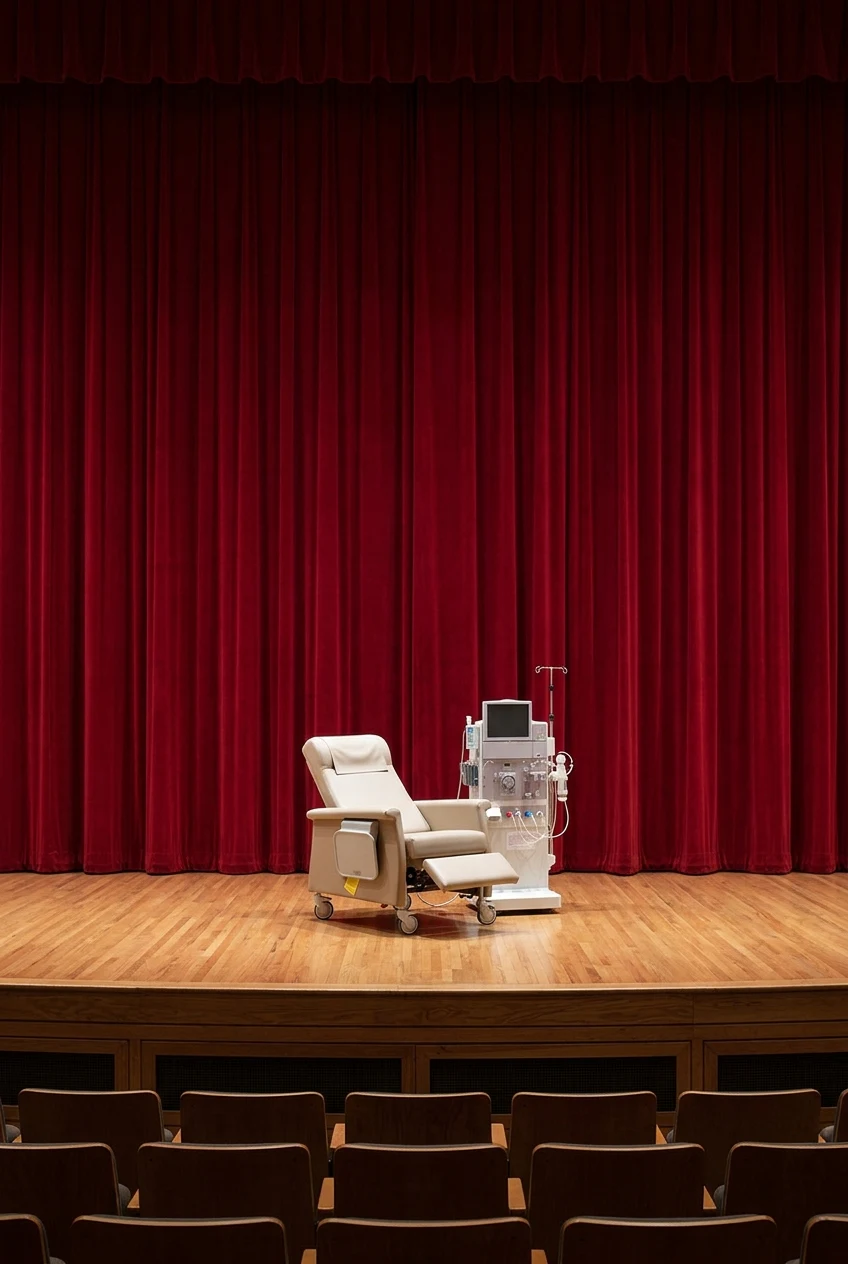
I spent years working in outpatient hemodialysis, first as a technician and later as a nurse. One of the first things an educator taught me was that you are always on stage.
At the time, I understood it as a lesson about how to carry myself on the floor. The patients came three times a week and sat in the same room for three or four hours while a machine moved their blood through a filter and returned it to them. They could sleep, read, talk, or watch television, but they were also watching us. They saw how we spoke to each other, how we responded to an alarm, how we treated the person in the next chair, and what happened to our composure when the day became difficult.
There was another reason they paid attention that I did not have to think about in the same way. For many of the patients I cared for, treatment began with two 15-gauge needles in the arm, one carrying blood toward the machine and the other bringing it back. Close to 300 milliliters of blood might be outside the body at a time, moving through the circuit at around 400 milliliters a minute.
Those numbers became ordinary to us because we worked around them every day. They were not ordinary to the person in the chair. There is something about seeing your own blood move out of your body that makes you vigilant about the room and the people you have entrusted with your care. Who is putting those needles in? Who notices when something changes? Who remains steady when an alarm sounds? You unavoidably start gauging who you can trust.
So being told that I was always on stage was not really an invitation to perform. It was a reminder that the patient was already forming an opinion about whether I was someone they could trust, and that the answer would come from more than the parts of my work I considered important.
What they are learning
I think that is why the phrase came back to me after I became a father.
You are always on stage as a parent. Your children watch how you handle things, how you react, how you speak, how you move through frustration, and how you carry yourself when the day does not go the way you expected. They listen when you are trying to teach them, but they are also listening when you think the conversation is over their heads or that they are distracted by something else. Whether you mean to teach them or not, something is being taught.
I have always cared about being an intentional father. I think about what I want my children to understand about discipline, curiosity, responsibility, love, and how to move through the world. I want to be able to explain why I believe what I believe instead of handing down a collection of habits that I never stopped to question.
But I am starting to see how intention can become a blind spot of its own. If I spend all of my attention on the lesson I mean to give, I can miss the lesson that actually reaches them.
That is the part of the stage metaphor that does not quite hold. A stage suggests that I know when the performance has begun. It suggests that there is a backstage where I can step out of view, collect myself, and become private again. Parenthood does not work that neatly. I do not get to decide which moments count simply because I know which ones I prepared.
The seams
This is what I mean when I say parenthood shows you your seams.
Parenthood does not necessarily create your impatience, fear, need for control, or contradictions. It reveals where those things were already joined together. The pressure usually arrives in ordinary ways. A plan changes after I have organized the day around it. A question comes back after I am sure I have answered it. I am tired, distracted, or carrying a private worry, and someone asks me for something simple. What happens next tells my children something about me, even if the moment has nothing to do with the lesson I would have chosen.
The pressure also keeps changing because the child keeps changing. A newborn can reveal how I respond to helplessness and uncertainty. Repetition finds something else. Later there will be questions that authority cannot answer, independence that I cannot manage on someone else's behalf, and decisions I may have to respect even when I disagree with them. Just when I learn how to carry myself under one kind of pressure, my child develops into someone capable of applying another.
There is no final version of me that can get ready once and remain ready for every stage. My children are growing, but the parent is continually being revealed too.
What lands
I know from being a son that a parent can have reasons a child cannot see. The parent may be trying to protect, prepare, or provide. The child lives with what that effort feels like from the receiving end. Those two accounts may overlap, but they are not the same account.
That is difficult to hold because intention is the part I can explain. I know the worry behind a rule, the history behind a reaction, and the love behind the pressure. Those reasons matter. They may even change how a moment should be understood. But they cannot tell me everything about what it was like for someone else to live through that moment with me.
Researchers who study how children learn to handle emotion describe three paths through family life. Children watch and model the adults around them. They receive direct instruction. They also absorb the broader emotional climate of the home. I keep returning to that because only one of those paths waits for me to decide that I am teaching.
My children are not only learning from what I say about frustration. They are living near what frustration does to me. They are not only hearing what I say about apology, respect, or love. They are watching what those things require of me when I am tired, when I feel misunderstood, or when admitting that I was wrong costs me something.
I do not think the answer is to become more self-conscious every minute of the day. That would turn parenthood into a performance, and children are close enough to see through that anyway. Maybe the more useful work is to become easier to reach after something has landed badly.
Can I hear their account before I explain my intention? Can I apologize without using the apology to defend myself? Can I let what they experienced change what I do next, even when I still believe my reasons were sincere?
Their account
On the dialysis floor, the patient in the chair was experiencing the same room I was working in, but not from the same position. I had the training, the routine, and the clinical reason behind what I was doing. The patient had the experience of placing their body in our care and watching what we did with that trust. My explanation mattered, but it could not replace the view from the chair.
One day my children will have their own account of what it was like to be raised by me. They may remember moments that I barely noticed and overlook things I worked hard to create. I will know what I meant, what I worried about, and what I was trying to give them. They will know what it felt like to live near those intentions while they were becoming themselves.
I do not know where those accounts will match or where they will pull apart. I think being an intentional father has to include remaining open to that difference. Otherwise, intention becomes a way of deciding in advance that the lesson I meant to give is the only one they were allowed to receive.
Maybe there is no backstage because there is no private version of my parenting that can overrule the version my children experienced. There is only the work of carrying myself with care, paying attention to what happens when the pressure changes, and being willing to hear what reached them when they are ready to tell me.
Source notes
- National Kidney Foundation, "Hemodialysis Access".
- Fresenius Medical Care, CombiSet SMARTECH bloodline instructions for use.
- Fresenius Medical Care, Optiflux dialyzer instructions for use.
- Amanda Sheffield Morris et al., "The Role of the Family Context in the Development of Emotion Regulation", Social Development 16, no. 2 (2007).